Physical Address
14 Da Souq St.
GN-947-2329, Tema.
Physical Address
14 Da Souq St.
GN-947-2329, Tema.

IT’S OFFICIAL. The FIFA 2026 World Cup took shape on Friday afternoon at the Kennedy Center in Washington DC, as 42 nations discovered their group stage fate in a star-studded ceremony that featured President Donald Trump, Tom Brady, Shaquille O’Neal, and a host of football legends. The historic 48-team tournament—the first of its kind—produced multiple Groups of Death, dream matchups, and favorable draws for all three host nations in a draw that sets the stage for next summer’s football extravaganza across North America.
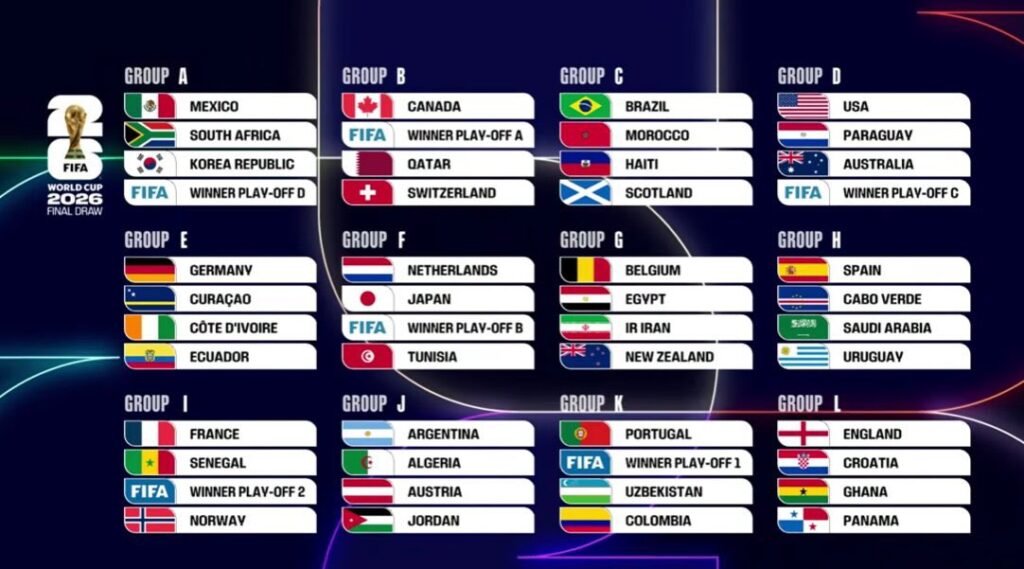
The United States will face Paraguay and Australia in Group D, a remarkably kind draw for the hosts that puts them in pole position to advance. Canada drew Switzerland and Qatar in Group B, while Mexico landed South Korea and South Africa in Group A. But elsewhere, the football gods delivered chaos. Brazil and Morocco—both 2022 World Cup semi-finalists—will clash in Group C. England face Croatia in a rematch of their 2018 semi-final. Spain must navigate Uruguay, while defending champions Argentina begin their title defense against Algeria and Austria.
Group A: Mexico, South Korea, South Africa, Playoff Winner (Denmark/North Macedonia/Czechia/Ireland)
Group B: Canada, Switzerland, Qatar, Playoff Winner
Group C: Brazil, Morocco, Scotland, Playoff Winner
Group D: USA, Australia, Paraguay, Playoff Winner
Group E: Germany, Ecuador, Ivory Coast, Playoff Winner
Group F: Netherlands, Japan, Tunisia, Playoff Winner
Group G: Belgium, Iran, Egypt, Playoff Winner
Group H: Spain, Uruguay, Saudi Arabia, Playoff Winner
Group I: France, Senegal, Norway, Playoff Winner
Group J: Argentina, Austria, Algeria, Playoff Winner
Group K: Portugal, Colombia, Uzbekistan, Playoff Winner
Group L: England, Croatia, Panama, Playoff Winner
The remaining six spots will be determined in March 2026 through UEFA playoffs (four teams) and intercontinental playoffs (two teams). Italy, the four-time world champions currently in the UEFA playoffs, could end up in Pot 4 if they qualify—making them the most dangerous unseeded team in the tournament.
The United States could not have asked for a better outcome. Paraguay from Pot 3 and Australia from Pot 2 represent two of the weakest teams in their respective pots, giving the USMNT a clear path to winning the group and avoiding a nightmare Round of 32 matchup.
The Americans will open their World Cup campaign on June 12 against Paraguay at SoFi Stadium in Los Angeles. It’s a rematch of their recent friendly in November, which the USA won 5-1 in a performance that showcased the team’s attacking depth. Christian Pulisic, Folarin Balogun, and Ricardo Pepi all found the net in that dominant display, and they’ll be confident of repeating the result when it matters most.
Three days later on June 19, the USA travels north to Seattle’s Lumen Field to face Australia. The Socceroos qualified for the tournament but have struggled for form recently, making them a beatable opponent for a resurgent American side. The Seattle crowd—one of the most passionate in North America—will create an electric atmosphere that should favor the hosts.
The group stage concludes on June 25 back at SoFi Stadium, where the USA will face their Pot 4 opponent, determined by the March playoffs. Even if Italy emerges from that gauntlet, the Americans will fancy their chances after two matches to build momentum and confidence.
Mauricio Pochettino’s side enters the tournament with genuine belief. The Argentine manager has transformed the USMNT since taking over, implementing a more aggressive, possession-based style that maximizes the talents of Pulisic, Weston McKennie, Tyler Adams, and emerging stars like Balogun. A favorable draw only strengthens their chances of a deep run.
All three host nations were handed favorable paths, raising eyebrows about the seeding system. Mexico will open the entire tournament on June 11 at the legendary Estadio Azteca in Mexico City, facing South Africa. It’s a massive occasion for El Tri, who will play at the Azteca for the third World Cup—a record for any stadium.
South Africa, ranked among Pot 3’s weaker teams, represents an ideal opening opponent. Mexico then faces South Korea on June 18 in Guadalajara before returning to the Azteca on June 24 for their final group match. If Mexico can’t advance from this group, it would be a catastrophic failure for a program desperate to break their Round of 16 curse that has haunted them for seven consecutive tournaments.
Canada drew Switzerland and Qatar in Group B, playing all three matches on home soil—twice in Vancouver and once in Toronto. The Swiss are always dangerous but beatable, while Qatar looked completely outclassed in their 2022 World Cup as hosts. Canada’s young, talented squad led by Alphonso Davies should have enough quality to advance, especially with home support behind them.
While the hosts celebrated, others received nightmare draws. Group C immediately stands out as the toughest quartet. Brazil and Morocco—who both reached the 2022 World Cup semi-finals—will meet in their opening match, with Scotland also lurking as a dangerous opponent making their first World Cup since 1998.
Morocco’s incredible 2022 campaign, where they knocked out Spain and Portugal before falling to France in the semis, announced them as African football’s new power. They’ve won 18 consecutive matches and possess one of the world’s most organized defenses. Brazil, meanwhile, are chasing their sixth World Cup title and first since 2002. The clash between these two nations on June 16 will be must-watch television.
Group L brings England and Croatia together in a rematch of their thrilling 2018 World Cup semi-final, which Croatia won 2-1 after extra time. The Three Lions have dreamed of revenge ever since, and they’ll get their chance when the teams meet in their opening match. Croatia, remarkably, have reached the last four in two of the last three World Cups—an incredible achievement for a nation of just four million people.
Group H pairs Spain and Uruguay, two former world champions with rich World Cup history. Spain are the top-ranked team in the world and reigning European champions, while Uruguay won the 1930 and 1950 World Cups and remain a South American powerhouse. Both teams should advance, but the battle for first place will be fascinating.
Defending champions Argentina face Algeria in their opening match, a rematch of their 1-1 draw in the 2010 World Cup. Lionel Messi, now 38, confirmed this week that he hopes to be fit enough to represent La Albiceleste one final time, though he admitted he’ll make a day-by-day decision during Inter Miami’s preseason.
If Messi does play, it would complete one of football’s great stories. After years of international heartbreak, he finally won the World Cup in Qatar 2022, cementing his legacy as the greatest player of all time. Defending the title on North American soil, where he now plays his club football, would be the perfect ending.
Austria from Pot 2 provides a stern test—they’re ranked higher than any other Pot 2 team—while Algeria brings African unpredictability. Argentina should advance, but this group won’t be a cakewalk. The real intrigue comes in the knockout rounds, where Argentina cannot meet Spain until the final if both teams win their groups. That potential matchup—Messi vs. Lamine Yamal for football’s ultimate prize—has already captured imaginations worldwide.
Group I reunites France and Senegal, who met in the opening match of the 2002 World Cup. In one of the tournament’s greatest shocks, Senegal defeated the defending champions 1-0, setting the tone for France’s disastrous title defense. Les Bleus were eliminated in the group stage without scoring a goal.
This time, France are better prepared. Kylian Mbappe leads one of the world’s most talented squads, with depth across every position. But Senegal aren’t the underdog minnows from 2002. They won the 2021 Africa Cup of Nations and reached the Round of 16 in 2022, proving they belong among the elite. With Liverpool’s Sadio Mane retired but players like Kalidou Koulibaly and Edouard Mendy still performing, Senegal will make life difficult for Les Bleus.
Norway completes the group, bringing Erling Haaland—arguably the world’s best striker—to his first World Cup. The Manchester City goal machine has scored over 100 goals in 115 appearances for his club since 2022, an absurd rate that makes him the most feared striker on the planet. Norway haven’t qualified for a World Cup since 1998, making this tournament extra special for the Scandinavian nation.
Friday’s draw ceremony was pure FIFA spectacle. President Trump received the inaugural FIFA Peace Prize from Gianni Infantino before drawing the USA into Group D alongside Canadian Prime Minister Mark Carney and Mexican President Claudia Sheinbaum, who drew their respective nations.
The decision to award Trump the Peace Prize sparked immediate controversy, with critics pointing out the questionable timing and politics involved. But FIFA has never been shy about mixing politics and football, and Infantino’s close relationship with Trump is well-documented.
The draw itself was conducted by England legend Rio Ferdinand and broadcaster Samantha Johnson, with assists from Tom Brady, Shaquille O’Neal, Aaron Judge, and Wayne Gretzky. Brady drew Brazil into Group C, while O’Neal handled Pot 2 duties. The celebrity lineup reflected FIFA’s attempt to make the World Cup appealing to American sports fans who traditionally haven’t embraced football.
Musical performances from Andrea Bocelli, Robbie Williams, Nicole Scherzinger, and Lauryn Hill provided entertainment between pots, while the three official mascots—Clutch the Bald Eagle (USA), Maple the Moose (Canada), and Zayu the Jaguar (Mexico)—made appearances throughout the ceremony.
The 2026 World Cup represents the biggest change in tournament history. Expanding from 32 to 48 teams means 64 matches instead of 64—sorry, 104 matches over 39 days. Twelve groups of four will play a round-robin, with the top two from each group advancing to the Round of 32 alongside the eight best third-place finishers.
This format guarantees 32 of 48 teams advance to knockout stages, nearly doubling the old rate. Critics argue it dilutes the competition and removes drama from group stages. Supporters counter that it gives more nations the chance to experience football’s pinnacle and generates massive revenue.
The tournament begins June 11 when Mexico faces South Africa at Estadio Azteca. The final will be played July 19 at MetLife Stadium in East Rutherford, New Jersey, exactly 32 years after the USA hosted their first World Cup and Brazil defeated Italy on penalties at the Rose Bowl.
While 42 nations know their opponents, six spots remain up for grabs. The UEFA playoffs in March will determine four European qualifiers from a field that includes Italy, Wales, Bosnia-Herzegovina, Northern Ireland, Sweden, Poland, Ukraine, Albania, Turkey, Romania, Slovakia, Kosovo, Denmark, North Macedonia, Czechia, and Republic of Ireland.
Italy face the real possibility of missing a third consecutive World Cup after failing to qualify in 2018 and 2022. The four-time champions sit in Pot 4 if they qualify, making them the most dangerous unseeded team any group could draw. Wales, led by Gareth Bale during their 2022 qualification, hope to return without their talisman. Sweden and Poland both possess quality squads capable of advancing.
The intercontinental playoffs feature Jamaica facing New Caledonia, with the winner meeting DR Congo for a World Cup spot. In the other path, Bolivia meets Suriname, and the winner faces Iraq. Both finals take place March 31 in Mexico, with the winners drawn into their respective groups.
FIFA will release the complete match schedule on Saturday, December 6, assigning specific times and venues to every group stage fixture. This information is crucial for fans planning travel and for teams preparing logistics.
Over six million tickets have already been sold—a record at this stage—with the third sales phase beginning December 11. For the first time, fans can purchase tickets for specific matchups rather than generic group stage slots, driving up prices for marquee clashes like Brazil-Morocco and England-Croatia.
The 16 host cities across North America are preparing for the biggest sporting event in history. MetLife Stadium in East Rutherford will host nine matches, the most of any venue, including the final. The Rose Bowl, Arrowhead Stadium, AT&T Stadium, Mercedes-Benz Stadium, and others will welcome the world’s best players to American soil.
For the USA, the draw represents a golden opportunity. Playing on home soil with a favorable group and the right coach at the helm, the Americans have everything aligned for a special tournament. The question is whether they can handle the pressure and expectations.
Takeaway: The 2026 FIFA World Cup draw at the Kennedy Center in Washington DC produced 12 groups for the historic 48-team tournament. The USA landed a favorable draw in Group D alongside Paraguay and Australia, while fellow hosts Canada and Mexico also received kind paths. Brazil face Morocco in Group C’s clash of 2022 semi-finalists, England meet Croatia in a 2018 rematch, and defending champions Argentina begin against Algeria and Austria. Spain drew Uruguay, France face Senegal, while Portugal must navigate Colombia and Uzbekistan. Six playoff spots remain to be decided in March, with Italy potentially becoming Pot 4’s most dangerous team. The tournament kicks off June 11, 2026 when Mexico play South Africa at Estadio Azteca, with the final on July 19 at MetLife Stadium. FIFA will release the complete match schedule on December 6, with over six million tickets already sold for football’s biggest event.
Read more: https://offsidetalk.com/2026-world-cup-host-cities/
Also: https://x.com/Juezcentral/status/1997020992040849551?s=20
Comments are closed.





[…] Read Also: https://offsidetalk.com/2026-world-cup-draw-groups/ […]