Physical Address
14 Da Souq St.
GN-947-2329, Tema.
Physical Address
14 Da Souq St.
GN-947-2329, Tema.

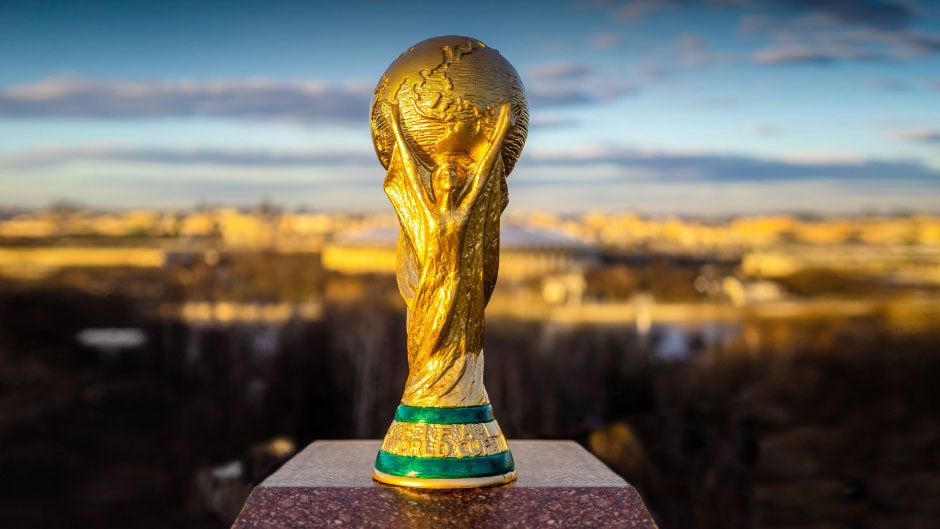
2026 World Cup draw took place today, December 5 in Washington DC. All four pots confirmed with Spain and Argentina leading 48-team tournament seeding.
THE STAGE IS SET. On December 5 at the Kennedy Center in Washington DC, football’s most anticipated event will unfold as 48 nations discover their fate for the 2026 FIFA World Cup. With the draw just days away, all four pots have been confirmed, setting up potential Groups of Death and dream matchups across the United States, Canada, and Mexico next summer.
This marks the first-ever 48-team World Cup, expanding from the traditional 32-team format. The nations will be divided into 12 groups of four, with the top two from each group plus the eight best third-placed teams advancing to a brand-new Round of 32. It’s the biggest restructuring in World Cup history, and the draw will determine which teams face the toughest roads to glory.
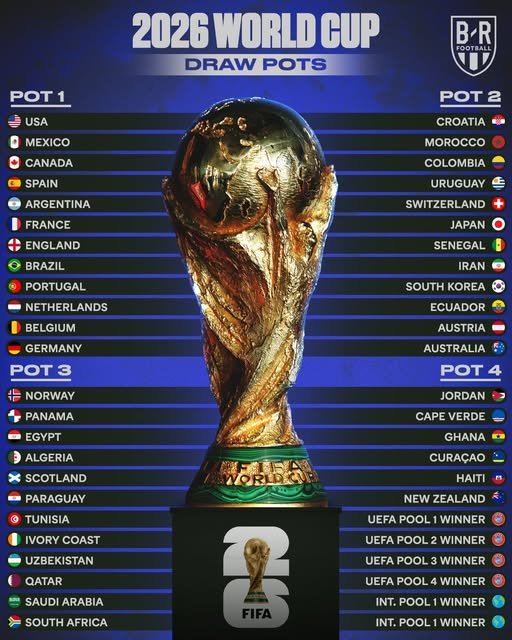
Pot 1 features the three host nations—United States, Canada, and Mexico—alongside the world’s nine highest-ranked teams: Spain, Argentina, France, England, Brazil, Portugal, Netherlands, Belgium, and Germany. This powerhouse collection represents football’s traditional superpowers plus the three automatic qualifiers.
Spain tops the FIFA rankings, followed by Argentina, France, and England. The reigning world champions from Argentina will be looking to defend their crown, while Spain enters as Euro 2024 winners with one of the youngest and most exciting squads in the tournament.
The hosts have been pre-assigned to specific groups to ensure they play in their home countries. Mexico will anchor Group A, Canada takes Group B, and the United States headlines Group D. This guarantees each host nation maximum home support during the group stage.
For the United States, this represents their best chance at World Cup glory since 1994. The USMNT will face a Pot 3 opponent on June 12 in Los Angeles, a Pot 2 team on June 19 in Seattle, and finish against a Pot 4 side back in Los Angeles on June 25. The middle match against a Pot 2 opponent will likely determine their group fate.
England enters the tournament as perennial underachievers despite their ranking, while Brazil seeks to end a 24-year drought since their last World Cup triumph. Germany and France, with their blend of experience and young talent, remain among the favorites despite recent struggles.
Pot 2 consists of the next 12 highest-ranked qualified teams: Croatia, Morocco, Colombia, Senegal, Uruguay, Japan, Ecuador, Switzerland, Austria, South Korea, Iran, and Norway.
This pot is loaded with teams capable of upsetting the elite. Croatia, fresh off their 2022 World Cup semi-final appearance, have proven they can compete with anyone. Morocco’s historic run to the 2022 semi-finals has elevated them to genuine contenders, and they enter as favorites to win the upcoming Africa Cup of Nations on home soil.
Norway’s inclusion marks the return of Erling Haaland to the World Cup stage, making them one of the most feared Pot 2 opponents. Japan dominated Asian qualifying and have consistently proven themselves as giant-killers in recent tournaments. Uruguay brings South American grit despite recent struggles, while Senegal represents African power alongside Morocco.
The European contingent of Switzerland, Austria, and Croatia ensures that no Pot 1 team can afford complacency. Any group featuring one of these nations alongside a top seed will immediately be labeled a potential Group of Death.
Pot 3 features Norway, Panama, Egypt, Algeria, Scotland, Paraguay, Tunisia, Ivory Coast, Uzbekistan, Qatar, Saudi Arabia, and South Africa. These teams occupy the middle ground—dangerous on their day but vulnerable to upsets.
Scotland returns to the World Cup for the first time since 1998, bringing passionate support and a physical style that could trouble bigger names. Egypt and Algeria provide North African representation, with both nations boasting talented squads capable of advancing if they find form.
Panama represents Central America’s rise in CONCACAF football, having qualified through a competitive regional tournament. Their 2018 World Cup debut showed they belong on this stage, and they’ll be hungry to prove it wasn’t a fluke.
Uzbekistan makes their World Cup debut, having dominated their qualifying group. They’re an unknown quantity that could surprise, similar to Iceland in 2018 or Morocco in 2022. Qatar, the 2022 hosts, enters with tournament experience and home advantage in the Gulf region eliminated.
Paraguay and Ivory Coast bring historical pedigree, though both have struggled recently. Saudi Arabia shocked Argentina in 2022’s opening match, proving that rankings mean little when teams rise to the occasion.
Pot 4 contains Jordan, Cape Verde, Ghana, Curaçao, Haiti, and New Zealand, plus six placeholders for teams still competing in March playoffs. This is where the World Cup’s expansion shows its impact most dramatically.
Jordan and Cape Verde make their World Cup debuts, while Curaçao became the smallest nation ever to qualify for the tournament. Haiti returns to the World Cup for the first time since 1974, a 52-year absence that makes their qualification one of the tournament’s feel-good stories.
Ghana, a nation that reached the 2010 quarter-finals, finds itself in Pot 4 due to recent struggles. The Black Stars failed to even qualify for this year’s Africa Cup of Nations, highlighting how far they’ve fallen. Still, their experience and talent make them dangerous.
New Zealand represents Oceania, having navigated their confederation’s qualifying process. They’ll be massive underdogs but will relish the opportunity to test themselves against the world’s best.
The six playoff spots remain to be decided. Four will come from UEFA’s playoffs in March, where 16 European teams battle for the final continental spots. The other two spots will be decided via intercontinental playoffs, with DR Congo and Iraq seeded directly to finals while Jamaica, Bolivia, New Caledonia, and Suriname compete in semifinals.
The draw takes place at 12:00 PM EST on December 5 at the Kennedy Center in Washington DC, with FIFA President Gianni Infantino and US President Donald Trump expected to attend.
Each team’s name is written on paper inside a plastic ball, placed in large glass bowls representing the four pots. Representatives—often soccer legends or celebrities—will draw one ball from each pot, with a computer allocating teams to groups based on geographical restrictions.
Teams from the same confederation cannot be drawn together, with one crucial exception: UEFA. With 16 European teams qualifying and only 12 groups available, four groups will contain two UEFA nations while the remaining eight groups have just one European team.
To ensure competitive balance, Spain and Argentina will be randomly placed in opposite pathways, as will France and England. This prevents the two highest-ranked teams from meeting before the final, assuming both win their groups.
The three host nations have been pre-allocated to ensure their group stage matches occur in their home countries. Mexico opens the tournament on June 11 at the iconic Estadio Azteca in Mexico City, marking the third time the stadium has hosted a World Cup opener—a record.
Every World Cup draw produces at least one “Group of Death,” and 2026 will be no exception. Imagine these nightmare scenarios:
Group of Death Option 1: England, Croatia, Egypt, Ghana. This group would pit two European powers against African threats with World Cup pedigree.
Group of Death Option 2: Brazil, Morocco, Scotland, Cape Verde. The five-time champions facing the 2022 semi-finalists, plus two teams with nothing to lose.
Group of Death Option 3: Germany, Norway (with Haaland), Algeria, New Zealand. Three dangerous teams from different continents with the Kiwis likely to be overwhelmed.
The host nations theoretically have easier paths by being seeded, but they’ll still face one Pot 2 opponent that could prove decisive. For the USMNT, their most difficult match will likely be against the Pot 2 opponent in Seattle, where they’ll need maximum points to guarantee advancement.
Before the full tournament lineup is confirmed, six more teams must emerge from March playoffs. The UEFA playoffs feature 16 nations competing in four paths, with single-leg semifinals on March 26 and finals on March 31.
Playoff Path A sees Italy face Northern Ireland while Wales meets Bosnia and Herzegovina. The four-time world champions desperately need to avoid a third consecutive playoff failure after missing 2018 and 2022.
Path B features Ukraine versus Sweden and Poland against Albania, a potentially explosive route with three nations capable of advancing. Path C includes Turkey, Romania, Slovakia, and Kosovo, while Path D pits Denmark against North Macedonia and Czechia versus Republic of Ireland.
For the intercontinental playoffs, semifinals take place March 26 with New Caledonia facing Jamaica in Guadalajara and Bolivia meeting Suriname in Monterrey. The finals on March 31 will see the semifinal winners face DR Congo and Iraq respectively, with both matches in Mexico.
The expanded format fundamentally changes World Cup strategy. With 32 of 48 teams advancing to the knockout rounds—the top two from each group plus eight best third-place teams—the margin for error increases dramatically.
Teams that might have been eliminated in previous tournaments now have lifelines. A shocking opening defeat no longer spells doom. But this also means the group stage could lose some drama, with many matches essentially meaningless once teams secure advancement.
The new Round of 32 adds another knockout match before the traditional Round of 16, meaning champions will play seven matches instead of six. Depth and squad management become even more critical, potentially favoring nations with stronger leagues and larger talent pools.
Geography plays a massive role. The tournament spans 16 cities across three countries, with AT&T Stadium in Arlington, Texas hosting nine matches—the most of any venue. Travel distances dwarf previous World Cups, adding a logistical challenge European teams haven’t faced in decades.
With the draw just days away, speculation runs rampant about potential matchups. Social media buzzes with fans hoping for—or dreading—specific opponents. Coaches study scouting reports. Players anxiously await their fates.
An updated match schedule assigning each fixture to specific stadiums and kickoff times will be released on December 6, one day after the draw. This will give teams concrete information about their group stage journey, allowing them to plan training camps and logistics.
The tournament promises to be the most competitive in history. The expansion to 48 teams brings new nations into the fold, creating Cinderella story potential alongside traditional powerhouses. Debutants like Curaçao and Jordan will have World Cup memories regardless of results, while giants like Brazil and Germany face immense pressure to reclaim former glory.
For host nations, the stakes couldn’t be higher. Mexico seeks redemption after failing to escape the Round of 16 in seven consecutive tournaments. Canada aims to build on their 2022 return after 36 years away. The United States, with the largest talent pool in program history, faces enormous expectations to deliver on home soil.
Takeaway: The 2026 FIFA World Cup draw on December 5 will divide 48 nations into 12 groups of four teams based on FIFA rankings. Pot 1 features hosts USA, Mexico, and Canada alongside powerhouses Spain, Argentina, France, England, Brazil, Portugal, Netherlands, Belgium, and Germany. Pot 2 includes dangerous opponents like Croatia, Morocco, and Norway with Erling Haaland. Pot 3 brings wildcards such as Scotland and Egypt, while Pot 4 contains debutants Jordan, Cape Verde, and Curaçao plus six playoff qualifiers to be determined in March. The draw procedure ensures no same-confederation clashes except for UEFA, with four groups containing two European teams. With the expanded format sending 32 of 48 teams to the knockout rounds, the tournament promises unprecedented drama when it kicks off June 11, 2026 in Mexico City.
Read more: https://offsidetalk.com/2026-world-cup/